The most expensive mistake we see in Jackson isn't a collapsed wall — it's a foundation designed with generic shear strength assumptions pulled from a textbook that never met Yazoo clay. That clay is a high-plasticity, overconsolidated beast. It swells when it rains, shrinks when it's dry, and its undrained shear strength can drop 40% with just a 2% increase in moisture content below the Pearl River floodplain. A standard unconfined compression test won't tell you that story. You need a consolidated-undrained triaxial test with pore pressure measurement to catch the effective stress envelope that actually governs long-term stability. Our Jackson lab runs these tests under ASTM D4767 protocols because we've seen too many projects on Lakeland Drive where the numbers on paper didn't match the numbers underground. Before you pour concrete near the Ross Barnett Reservoir or anywhere in Hinds County with fat clays, pairing a CPT test with a triaxial program gives you the full picture — tip resistance from the cone, strength parameters from the lab.
Yazoo clay doesn't fail the way your textbook predicted — but a properly interpreted triaxial test will show you exactly how it does.
Local geotechnical context
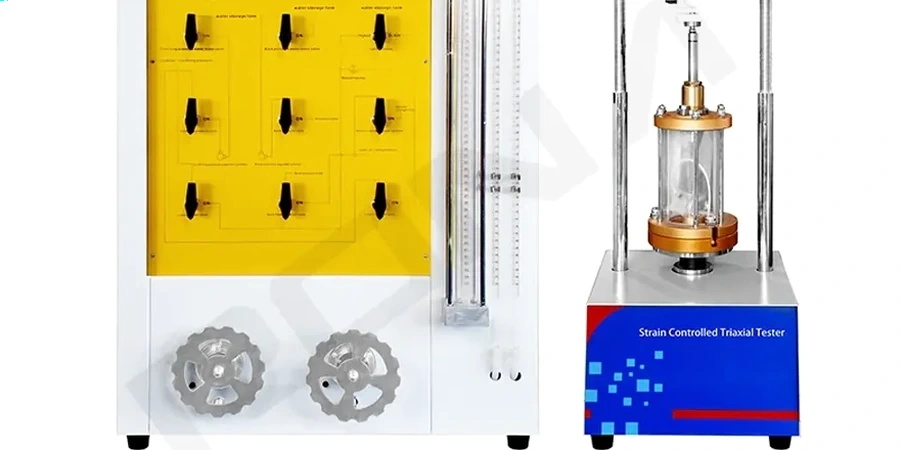
The triaxial cell itself is a transparent chamber about the size of a coffee can, with a latex membrane stretched around a trimmed soil cylinder and three ports feeding de-aired water at controlled pressures. In Jackson's high-plasticity clays, the trick isn't the shear stage — it's the saturation and consolidation stages, which can take three to five days per specimen if the back-pressure line has to dissolve every last bubble of air trapped in the smectite interlayers. Rushing that phase produces a B-value below 0.90, and suddenly your measured undrained strength is 15% too low. We had a project off I-55 near the Pearl River where contractor-supplied lab results from an out-of-state firm gave a cohesion intercept of 200 psf. Our triaxial program on the same boring returned 320 psf after proper saturation. The difference was a $90,000 overdesign on the mat foundation that got caught before the rebar order went in. The physical setup in our Jackson lab runs four triaxial cells in parallel, each with independent digital pressure-volume controllers, so we can run a full CU series at three confining pressures without compressing the project schedule.
Quick answers
How much does a triaxial test program cost for a Jackson project?
A full CU triaxial series (three specimens at three confining pressures with pore pressure measurement) typically ranges from US$2,140 to US$3,060, depending on the number of borings, specimen preparation time for high-plasticity clays, and whether we need to run companion index tests like Atterberg limits. A single UU test runs on the lower end. The number that matters more is the value of the foundation design decision it supports — a triaxial program that costs $2,500 can easily identify $15,000 in unnecessary concrete if your soil is stronger than the conservative default assumptions most engineers use for Yazoo clay.
What's the difference between a triaxial test and an unconfined compression test?
An unconfined compression test shears the specimen with zero confining pressure and no pore pressure measurement. It gives you a single undrained strength value that's only reliable for saturated, intact clays tested immediately after extrusion. A triaxial test applies controlled confining pressure to replicate the in-situ stress state, measures pore pressure during shear, and produces effective stress parameters (c' and φ') that you can use for both drained and undrained analysis. In Jackson's stiff fissured clays, unconfined tests routinely underestimate field strength because sample disturbance releases negative pore pressure. The triaxial fixes that.
How long does triaxial testing take from sample delivery to report?
For a standard CU triaxial series on Jackson clays, expect 10 to 14 business days. The bottleneck is saturation: high-plasticity Yazoo clay specimens often need 48 to 72 hours of back-pressure saturation to reach a B-value above 0.95. Consolidation adds another 24 to 48 hours per specimen depending on permeability, and shear at the correct strain rate takes 8 to 12 hours per specimen. We run four cells in parallel, so a three-specimen CU series doesn't take three times as long as a single test. Rush turnaround is available with an overtime surcharge.
Do I need drained or undrained triaxial parameters for my Jackson retaining wall design?
You probably need both, but the critical case depends on your wall type and the drainage conditions. For a cantilever wall backfilled with granular material, use drained parameters (CD triaxial) for the long-term condition — the clay will eventually reach equilibrium with the new stress state. For a sheet pile wall in soft clay where construction loads are applied quickly, undrained parameters (CU triaxial) govern short-term stability. We typically recommend running a CU series with pore pressure measurement as the primary program, because it gives you both undrained strength and effective stress parameters from one set of specimens. The report includes separate design envelopes for short-term and long-term conditions.