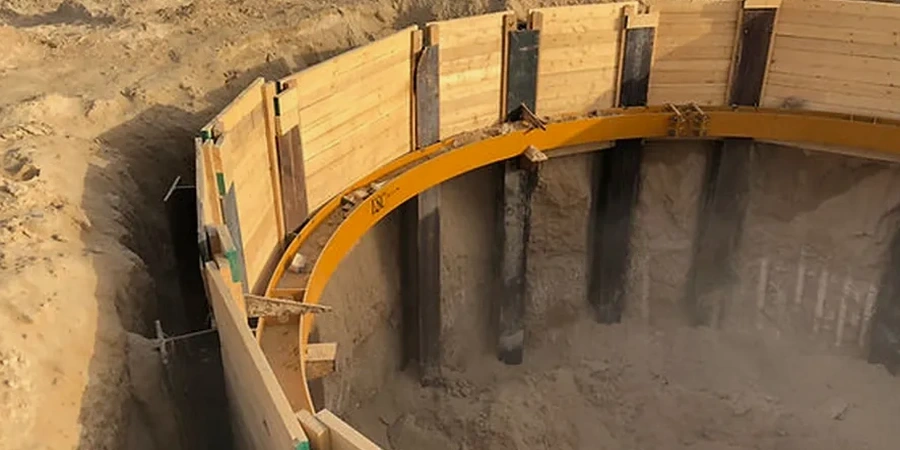
A five-story medical office building planned near the University of Mississippi Medical Center on State Street encountered 45 feet of highly plastic Yazoo clay before reaching competent bearing strata. The structural engineer called for a deep foundation solution, and that is where pile design becomes the critical path. In Jackson, the subsurface profile rarely cooperates with shallow footings. The Pleistocene terrace deposits and underlying Cockfield Formation provide bearing capacity, but reaching them demands careful selection between driven H-piles, augered cast-in-place piles, or prestressed concrete piles. Each option interacts differently with the expansive clays that dominate the Jackson Prairie region. Our laboratory performs site-specific soil characterization — including Atterberg limits and undrained shear strength profiles — to feed the axial and lateral pile analysis. We never assume a single pile type fits all zones of the city. The geotechnical variability between downtown Jackson alluvium and the loess-mantled uplands east of I-55 requires distinct design parameters, and the triaxial shear testing we conduct provides the drained and undrained strength envelopes that govern side friction and end bearing calculations.
Driven pile refusal on the Cockfield Formation typically occurs between 55 and 80 feet in central Jackson, but the friction contribution from the Yazoo clay above requires careful strain-compatible design.
How we work
Jackson sits at roughly 280 feet above sea level along the Pearl River floodplain, with a population approaching 150,000 in a metropolitan area of nearly 600,000. The geologic setting is defined by the Jackson Group formations overlying the thick Wilcox and Claiborne sedimentary sequences. Pile design in this context must address two primary challenges: the shrink-swell potential of near-surface Yazoo clay, which can exert uplift forces on pile caps, and the depth to competent bearing material, often exceeding 60 feet in the river-adjacent corridors. A standard driven pile log through Jackson soils will transition from stiff fat clay into dense sands or the weathered Yazoo marl before reaching the Cockfield sand and claystone. Our design methodology follows IBC Chapter 18 coupled with ASCE 7 load combinations, integrating site-specific seismic parameters for Seismic Design Category B or C depending on the site class derived from
MASW shear wave velocity profiling. We develop t-z and Q-z curves calibrated to local CPT data — and where CPT refusal occurs on dense sands, the
standard penetration test drilling supplements refusal verification and sample recovery for laboratory index testing. Lateral pile response under the design earthquake and wind loads is analyzed using LPILE or equivalent p-y methods, with p-y curves modified for the strain-softening behavior observed in Jackson's overconsolidated clays.
Local geotechnical context
Jackson's urban expansion since the 1960s pushed commercial development onto the Yazoo clay plains north and east of the original downtown grid, where early buildings on shallow footings experienced differential movement that persists in some older structures along North State Street and Ridgewood Road. The risk with pile foundations here is not bearing failure — it is the interaction between the deep foundation element and the moving ground around it. When the upper clay layer undergoes seasonal moisture cycling, the swelling pressure can exceed 5,000 psf, and if a pile cap is cast in contact with this active zone, uplift forces transfer to the pile group in ways that simplified elastic models miss. A second risk involves downdrag: as soft alluvial or fill materials consolidate over time, negative skin friction loads accumulate along the upper pile segment, reducing net available geotechnical capacity unless explicitly accounted for in the neutral plane analysis. We also see constructability challenges where artesian conditions in the Cockfield sand create drilling instability for augered cast-in-place piles; temporary casing or drilling fluid management becomes necessary. Each of these failure modes — structural overstress from drag load, heave-induced tension in rigid connections, and installation-induced soil disturbance — is addressed in our design through instrumented load test verification and conservative strain limits on the structural section.
Quick answers
What is the typical cost range for a pile foundation design package in Jackson?
A complete design package — including geotechnical investigation, laboratory testing, pile capacity analysis, and stamped construction documents — generally ranges from US$1,720 to US$6,620, depending on the number of borings, depth to bearing stratum, and whether lateral load or seismic analysis is required. Projects with multiple pile load tests or complex group configurations fall toward the upper end of that range.
Which pile type performs best in Jackson's Yazoo clay?
Driven H-piles and prestressed concrete piles both perform well when designed with adequate embedment into the Cockfield Formation. Augered cast-in-place piles can be effective but require careful drilling fluid management if artesian sand layers are encountered. The optimal selection depends on site access, proximity to vibration-sensitive structures, and the contractor's equipment availability.
How do you account for expansive clay effects on pile foundations?
We evaluate the active zone depth — typically 15 to 25 feet in Jackson — from laboratory swell pressure and moisture content profiles. The design isolates the pile cap from the expansive zone using void forms or an air gap, and we verify that the pile structural section can resist uplift forces transmitted through friction in the upper clay. Neutral plane analysis separates the drag load from the true geotechnical capacity for axial compression design.
What seismic provisions apply to pile design in Jackson?
Jackson falls under Seismic Design Category B or C per ASCE 7, depending on the site class determined from shear wave velocity measurements. Pile design must satisfy the overstrength and redundancy requirements of ASCE 7 Section 12.13, including lateral displacement compatibility at the pile head and ductile detailing in the connection zone. We model the soil-pile system using p-y springs calibrated to the site-specific modulus degradation curves.