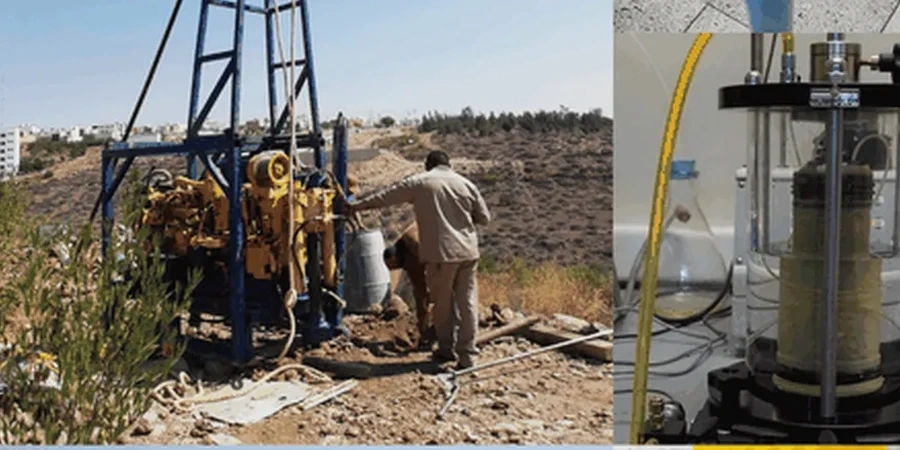
Jackson sits on the Jackson Prairie belt, where the Yazoo Formation clay dominates the subsurface. That clay shrinks and swells with every rain and dry spell—anyone who has lived here through a wet winter and a scorching July knows it. A full soil mechanics study has to account for that volume change potential, not just bearing capacity. We see moisture contents in the Yazoo that swing from 22% to over 45% seasonal, and plasticity indices routinely exceeding 35. That is not a number to ignore when you are putting in a foundation on Ridgewood Road or preparing a pad in Fondren. Before the first bucket turns, we pull Shelby tubes and run one-dimensional swell-consolidation tests so the structural engineer knows exactly what to expect from the ground. In a city where the Pearl River floodplain kisses the edge of the prairie, the soil profile can flip from stiff tan clay to soft gray fat clay in 15 vertical feet, and connecting that data to the footings design is what keeps a slab from heaving before the drywall is up.
Yazoo clay in Jackson can swell 10% or more from dry to saturated—if the foundation grade is not designed around the swell index, the slab will telegraph the movement within two seasons.
Local geotechnical context
Drive from the clay hills of Northeast Jackson down toward the floodplain south of Highway 80, and the foundation risk shifts completely. In the northern neighborhoods, the Yazoo clay is stiff and overconsolidated from desiccation—bearing capacity is rarely the problem, but swell and shrink are. A slab poured without a moisture-conditioned pad and a properly designed retaining walls system for the cut can start showing edge heave within 12 months. Down near the river, you trade the swelling clay for loose alluvial sands and soft silts that bring a different threat: differential settlement and, in a seismic event, potential liquefaction. The USGS still maps a moderate seismic hazard across Hinds County, and a liquefaction screening using the Seed and Idriss simplified procedure is cheap insurance when the boring logs show saturated sand below the water table. The biggest risk in Jackson is treating every site like it is the same soil. It is not. The report has to reflect the specific geomorphic unit—prairie, terrace, or floodplain—or the earthwork contractor will be fighting the ground instead of working with it.
Relevant standards
ASTM D1586 – Standard Penetration Test (SPT) in boring, ASTM D2487 – Unified Soil Classification System, ASTM D4318 – Atterberg Limits (liquid limit, plastic limit, PI), ASTM D2435 – One-dimensional consolidation properties, ASTM D3080 – Direct shear test on undisturbed samples, IBC 2018 Chapter 18 – Soils and Foundations (adopted by Jackson)
Quick answers
What does a soil mechanics study for a single-family home in Jackson typically cost?
For a standard residential lot in the Jackson metro, the study including two borings to 25–30 feet, full lab testing on the Yazoo clay (Atterberg limits, swell-consolidation, direct shear), and a sealed geotechnical report with foundation recommendations runs between US$3,590 and US$5,950 depending on access, depth, and number of samples requiring swell testing.
How long does it take to get the final report after the drilling is done?
We usually wrap up field drilling in one day for a residential site. The lab needs 7 to 10 working days to complete the consolidation and swell tests because those are time-dependent procedures—the clay has to saturate and reach equilibrium. The final report is delivered electronically by day 12 to 14 after drilling, assuming no additional testing is requested.
Do you need to drill through the pavement if the lot already has an old driveway or slab?
Yes, we core through existing concrete or asphalt to get to the native soil underneath. Pushing a hand auger through a thin slab is not enough—we need Shelby tubes and split-spoon samples from undisturbed ground. We patch the core holes with cold-mix asphalt or concrete after the rig leaves, so the surface is usable again immediately.
What is the difference between a soil mechanics study and a standard soils report in Jackson?
A standard soils report often focuses on bearing capacity and maybe a PI number. A proper soil mechanics study goes deeper: we measure the swell pressure, the rate of consolidation, the drained friction angle, and the moisture-density relationship for compaction control. In Jackson, where the Yazoo clay controls everything, omitting the swell-consolidation data is the most common reason foundations move later.
Can the same study be used for the building permit and the site grading plan?
Yes. We write the report so it satisfies the IBC Chapter 18 requirements for the structural permit and also includes the moisture-conditioning and compaction specs that Jackson Public Works looks for in the grading and drainage submittal. One report, two purposes—that is how we structure the document from the start.