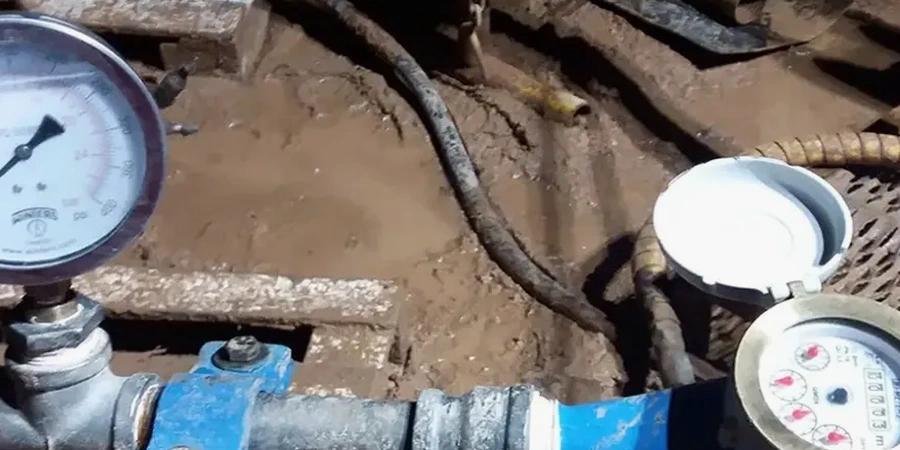
Jackson sits on the Yazoo Clay formation, a stiff overconsolidated marine clay that swells more than most engineers anticipate. At roughly 290 feet above sea level in the Pearl River valley, the city deals with perched water tables and interbedded silt lenses that make permeability assumptions risky. We run Lefranc tests in boreholes drilled through weathered Yazoo Clay to measure hydraulic conductivity where groundwater modeling demands localized data. For projects near the Ross Barnett Reservoir or along the Pearl River floodplain, we also apply the Lugeon method when rockhead is shallow and a grouting program may be needed to control seepage under foundation slabs or cutoff walls.
Assuming isotropic permeability in Yazoo Clay is the fastest way to underestimate pore pressure buildup under a mat foundation.
How we work
The contrast between a site in downtown Jackson and one in the Fondren district can be stark: downtown often hits the Cockfield Formation sandstone within 15 to 20 feet, while Fondren stays in stiff Yazoo Clay for 40 feet or more, holding perched water that drains slowly. In the sandstone, a Lugeon test gives us a direct read on fracture flow that controls dewatering design. In the clay-dominated profile, we rely on Lefranc falling-head tests to quantify the low-permeability behavior that governs consolidation time under embankment loads. Both methods run under IBC Chapter 18 guidelines, and we log every test with a calibrated pressure transducer so the data survives scrutiny during peer review by the Mississippi Department of Environmental Quality.
Quick answers
What does a field permeability test cost in the Jackson metro area?
A standard Lefranc test program with three test intervals, including rig mobilization within Hinds or Rankin County, runs between US$680 and US$1,040 per test interval. The final total depends on depth, access constraints, and whether we are already on site for SPT drilling. A Lugeon test in rock typically falls in the upper half of that range because it requires a double-packer assembly and longer stage durations.
When is a Lefranc test required instead of a lab permeability test?
Lab tests on Shelby tube samples give a point measurement that can miss fractures, silt seams, and macro-fabric features that control field-scale flow. The IBC requires field permeability testing when groundwater control is a design factor, and Jackson's interbedded Yazoo Clay profile rarely yields representative lab k-values because the sampling process smears fissures and destroys secondary structure.
How many test intervals do I need for a commercial building in Jackson?
Most commercial projects in Jackson need a minimum of three test intervals: one in the upper weathered clay zone (5 to 15 feet), one at footing depth, and one deeper interval to assess the vertical gradient. For sites within the 100-year floodplain, we add a fourth interval near the seasonal low-water mark to satisfy MDEQ dewatering permit requirements.
How long does the testing program take from mobilization to report?
Fieldwork for a three-interval Lefranc program typically takes one day with a track-mounted rig. Lugeon testing in rock adds half a day per interval because of the stepped-pressure protocol. We deliver the draft hydraulic conductivity report within five business days, with final stamped reports ready in seven to ten days after the last field day.