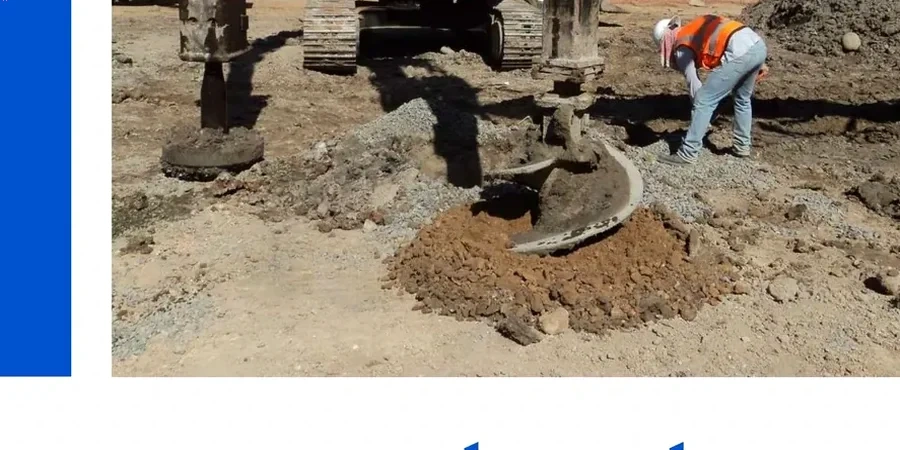
The contrast between Jackson's eastern loess bluffs and the alluvial floodplain downtown tells you everything about why foundation design varies block by block. In the Belhaven and Fondren areas, you find relatively stiff silty deposits that handle conventional footings without much trouble. Drop south toward the Pearl River or west into the floodplain, and the profile shifts to thick, compressible Yazoo clay that consolidates slowly and loses strength when saturated. That difference drives demand for vibrocompaction assessment when granular fills are present, and more often, for stone column design when the soft clay extends past 15 feet. Our geotechnical team runs field borings per ASTM D1586, correlates SPT blow counts with lab classification under ASTM D2487, and sizes the aggregate columns to match the settlement tolerance of each structure.
A well-executed stone column grid in Yazoo clay typically cuts total settlement by a factor of 2.5 to 4, turning marginal sites into buildable ground.
Local geotechnical context
Jackson's expansion from a trading post on the Pearl River bluffs into a sprawling capital city pushed development onto Yazoo clay deposits that earlier builders had deliberately avoided. The historic downtown stayed on the higher, stiffer ground near State Street, but mid-century suburban growth into south and west Jackson encountered deep, compressible clays that were never tested before construction. Those older structures now show differential movement, cracked slabs, and tilted floors that trace back to untreated soft ground. Stone column design addresses this by transferring structural load through compacted aggregate columns that densify and reinforce the clay mass. The risk comes from underestimation: if the preconsolidation pressure is misread, the columns still work, but the margin of safety narrows. We cross-check every design with lab consolidation tests on undisturbed Shelby tube samples to confirm the stress history before selecting column spacing.
Quick answers
What does stone column design typically cost for a Jackson commercial project?
The geotechnical design package, including field investigation, lab testing, and the stone column layout, runs between US$1,530 and US$4,500 depending on site access and number of borings. The construction-phase QA/QC work is priced separately based on the number of test columns required.
How deep do stone columns need to go in Yazoo Clay?
Most columns penetrate 15 to 30 feet, fully crossing the soft upper Yazoo Clay. The exact depth comes from the SPT blow count profile: we extend the column until the N-value exceeds 15 blows per foot consistently.
Does the high water table in Jackson affect stone column installation?
It actually helps. Wet top-feed vibro-replacement works below the water table by using water as a flushing medium. The saturated Yazoo clay also maintains better lateral confinement during aggregate compaction.
How long after installation can we start foundation work?
Stone columns are ready for loading immediately after compaction and verification testing. There is no curing period like concrete, so foundation construction can begin the same week the plate load test results are approved.