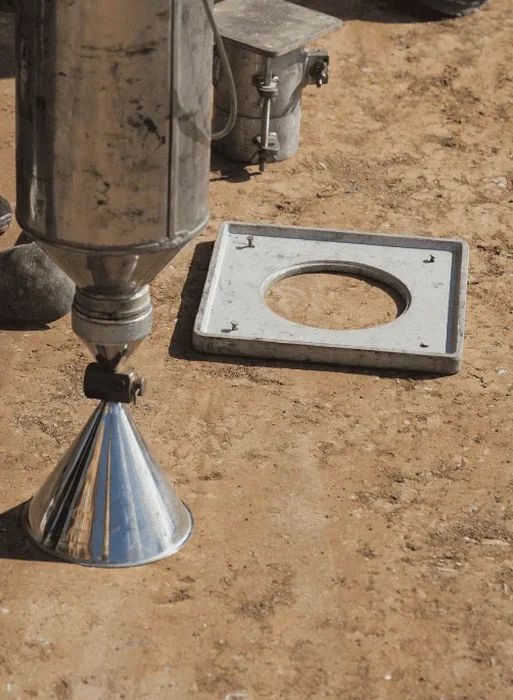
Jackson Mississippi sits atop the Jackson Dome, an ancient volcanic uplift that shaped the region's unique geology. The overlying Yazoo Clay formation dominates the shallow subsurface—a high-plasticity, expansive clay that swells dramatically with moisture changes and shrinks during the dry summer months. When placing engineered fill or compacting subgrade for commercial projects along Interstate 55 or residential developments near the Pearl River, achieving and verifying specified compaction is non-negotiable. The sand cone density test provides direct, reliable in-place density measurements that no nuclear gauge can match when dealing with the variable moisture conditions typical of central Mississippi. Our team runs these tests throughout Hinds, Rankin, and Madison counties, correlating results with laboratory Proctor curves to confirm that every lift meets the project specification before the next layer goes down.
A sand cone test gives you a number you can defend to the specifier—no calibration drift, no moisture interference, just a direct volume-to-mass relationship verified in the field.
Relevant standards
ASTM D1556 – Standard Test Method for Density and Unit Weight of Soil in Place by Sand-Cone Method, ASTM D1557 – Standard Test Methods for Laboratory Compaction Characteristics of Soil Using Modified Effort, ASTM D698 – Standard Test Methods for Laboratory Compaction Characteristics of Soil Using Standard Effort, ASTM D2216 – Standard Test Methods for Laboratory Determination of Water (Moisture) Content of Soil and Rock by Mass, IBC Section 1804 – Excavation, Grading, and Fill (referenced by Jackson building code)
Quick answers
What does a sand cone field density test cost in Jackson Mississippi?
For projects in the Jackson metro area, a single sand cone density test typically ranges from US$110 to US$130 per point, depending on site accessibility and whether the test location requires extended travel south toward Byram or north past Ridgeland. Volume pricing applies for multi-point testing on the same site visit.
How does the sand cone method compare to nuclear gauge testing?
The sand cone method measures density directly by excavating a small hole and measuring its volume with calibrated sand—there is no radiation source, no license requirement, and no moisture interference in the density reading. Nuclear gauges are faster but can give misleading readings in the highly plastic Yazoo Clay when moisture distribution is uneven. The sand cone also eliminates the regulatory paperwork associated with radioactive source handling on site.
How many sand cone tests are required per lift of fill?
The frequency depends on the project specification, but a common rule of thumb in Jackson commercial construction is one test per 2,500 square feet of compacted lift area, with a minimum of three tests per lift regardless of area. Mississippi DOT projects may specify tighter frequencies for roadway embankments. We always coordinate with the geotechnical engineer of record to confirm the required testing interval before mobilization.
Can the sand cone test be performed on granular base course material?
Yes, though the test hole must be larger—typically 5 inches in diameter per ASTM D1556—to accommodate the coarser particle sizes in crushed limestone or gravel base course commonly used under Jackson parking lots and roadways. The technician must also take extra care to prevent base course particles from collapsing into the hole during excavation, which would compromise the volume measurement.