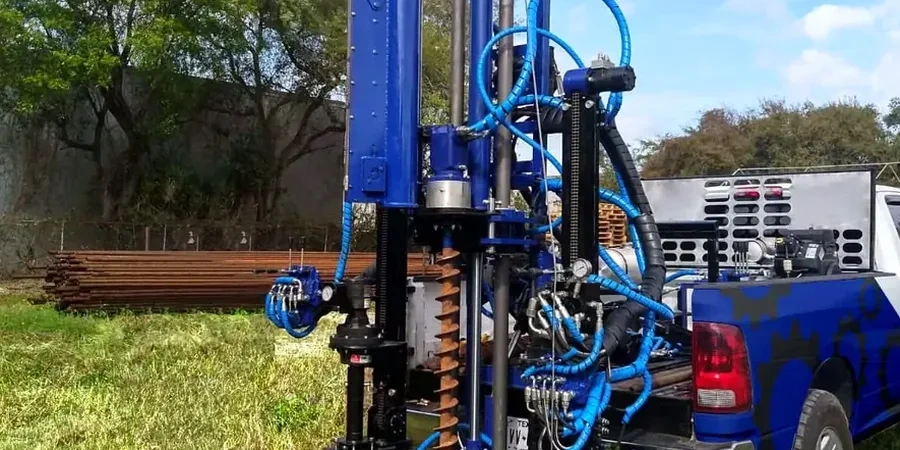
Jackson sits on the Jackson Prairie belt, where the near-surface geology shifts between Pleistocene terrace deposits and the notorious Yazoo clay — a high-plasticity, moisture-sensitive formation that has challenged foundation engineers across central Mississippi for decades. The summer humidity here often exceeds 90 percent, and when combined with the shrink-swell potential of the local clay, the soil can heave enough to crack slab-on-grade foundations within a single wet-dry cycle. That is exactly why the Standard Penetration Test remains the backbone of every site investigation we run in Hinds County. We deploy a CME-55 drill rig with an auto-trip hammer calibrated to ASTM D1586 energy standards, recovering split-spoon samples every 5 feet while recording blow counts that translate directly into bearing capacity estimates. For deeper liquefaction screening in the alluvial sands underlying the Pearl River floodplain south of downtown Jackson, we often pair the SPT with a seismic microzonation study to capture shear-wave velocity profiles that complement the penetration resistance data.
In Yazoo clay, the N-value alone doesn’t tell the full story — moisture content at the time of the test can shift the blow count by 30 percent between August and October.
Local geotechnical context
Jackson has a population of roughly 150,000, and much of the older housing stock north of Fortification Street rests on shallow spread footings that were designed before the Yazoo clay formation was well understood. The clay’s liquid limit routinely exceeds 70, with plasticity indices above 40, placing it squarely in the CH category of highly expansive soils. When a developer skips the Standard Penetration Test and relies solely on hand-auger borings, they miss the soft seams that can go undetected in the upper 15 feet — seams that have caused foundation failures in subdivisions near the Eubanks Creek drainage. The Mississippi State Board of Licensure for Professional Engineers and Surveyors expects geotechnical reports to include SPT-based bearing capacity calculations that reference the IBC soil profile categories, and lenders increasingly require the data before approving construction loans inside the Jackson city limits.
Quick answers
How much does an SPT investigation cost for a residential lot in Jackson?
For a standard residential lot in the Jackson metro area, an SPT program with two to three boreholes to 30 feet typically runs between US$490 and US$860 per borehole, depending on access conditions and the number of split-spoon samples required. The final scope and cost are always confirmed after a site walk.
How deep do you drill for an SPT in Jackson’s Yazoo clay?
Most residential and light commercial projects require 30 to 40 feet of penetration. We target at least 10 feet into the underlying stiff clays or sands so the foundation recommendation is based on a competent bearing stratum, not just the weathered crust.
What N-values indicate a problem for shallow footings in Jackson?
Consistent N-values below 4 in the upper 10 feet, combined with a moisture content above the plastic limit, signal a soft, compressible zone that usually requires either over-excavation and replacement or a transition to deep foundations.
Do you correct SPT N-values for hammer energy in Mississippi?
Yes, every blow count is corrected to N60 using the hammer energy ratio measured per ASTM D4633. We also apply overburden corrections following Liao and Whitman for granular soils, which is standard practice for liquefaction analysis referenced by the Mississippi DOT and the IBC.