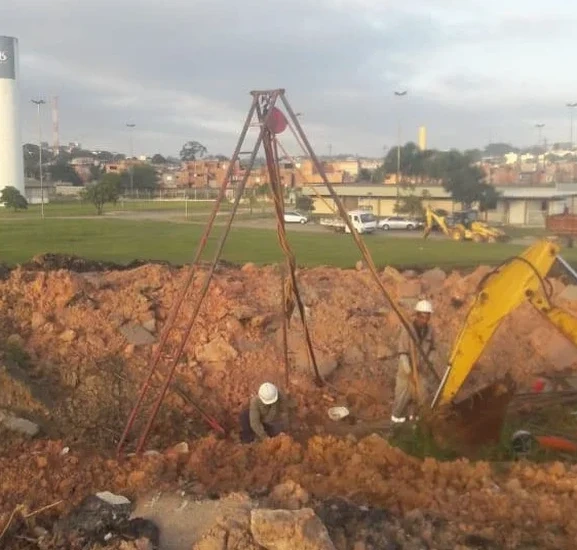
Jackson sits at 279 feet above sea level on the eastern bank of the Pearl River, built atop the infamous Yazoo Formation — a high-plasticity clay that swells in winter and shrinks during Mississippi's scorching 95-degree summers. Foundation distress in Belhaven, Fondren, and Eastover rarely comes from structural failure; it comes from ignoring what the soil does when moisture changes. Atterberg limits testing quantifies exactly that: the liquid limit where your subgrade turns to slurry, the plastic limit where it crumbles, and the shrinkage limit where it pulls away from footings. Our lab runs ASTM D4318 on every sample the same day it arrives. For deeper stratigraphy on commercial lots, we pair the limits with SPT drilling to map consistency with depth and flag organic lenses before they surprise you during excavation.
A plasticity index above 25 in Jackson's Yazoo clay means one thing: your slab needs ribs and your exterior grade needs drainage — no exceptions.
Relevant standards
ASTM D4318-17e1: Standard Test Methods for Liquid Limit, Plastic Limit, and Plasticity Index of Soils, ASTM D2487-17: Standard Practice for Classification of Soils for Engineering Purposes (Unified Soil Classification System), ASTM D2216-19: Standard Test Methods for Laboratory Determination of Water (Moisture) Content of Soil and Rock by Mass, IBC 2021 Chapter 18: Soils and Foundations, ASCE 7-22: Minimum Design Loads and Associated Criteria for Buildings and Other Structures
Quick answers
What do Atterberg limits testing cost for a residential lot in Jackson?
For a standard single-family lot, Atterberg limits testing (liquid limit, plastic limit, and plasticity index on one sample) runs between US$60 and US$90. A full investigation with multiple samples at different depths will be higher. We quote per-sample with no hidden setup fees.
How many samples do you need for a foundation investigation on Yazoo clay?
IBC requires at least one boring with samples at depth intervals not exceeding 5 feet. For Yazoo clay, we recommend sampling at 2.5-foot intervals in the upper 10 feet where moisture fluctuation is greatest. That typically means 4 to 6 Atterberg tests per boring, plus one from any suspected fill layer.
Can you run Atterberg limits on the same day the samples arrive?
Yes. Samples received by noon are in the lab that afternoon. Liquid limit requires overnight moisture conditioning for multi-point curves, so the full report goes out in 48 hours. If it's urgent, we can expedite a single-point liquid limit with plastic limit same-day and follow with the complete curve the next morning.
What plasticity index triggers a stiffened slab in Jackson?
Under the Post-Tensioning Institute (PTI) method adopted by Jackson building officials, a PI above 15 generally requires some form of ground improvement or a stiffened slab. Yazoo clay PIs of 30 to 45 make a ribbed or post-tensioned slab mandatory for slab-on-grade construction. Our report gives the PI at each depth so your structural engineer can model the exact heave profile.