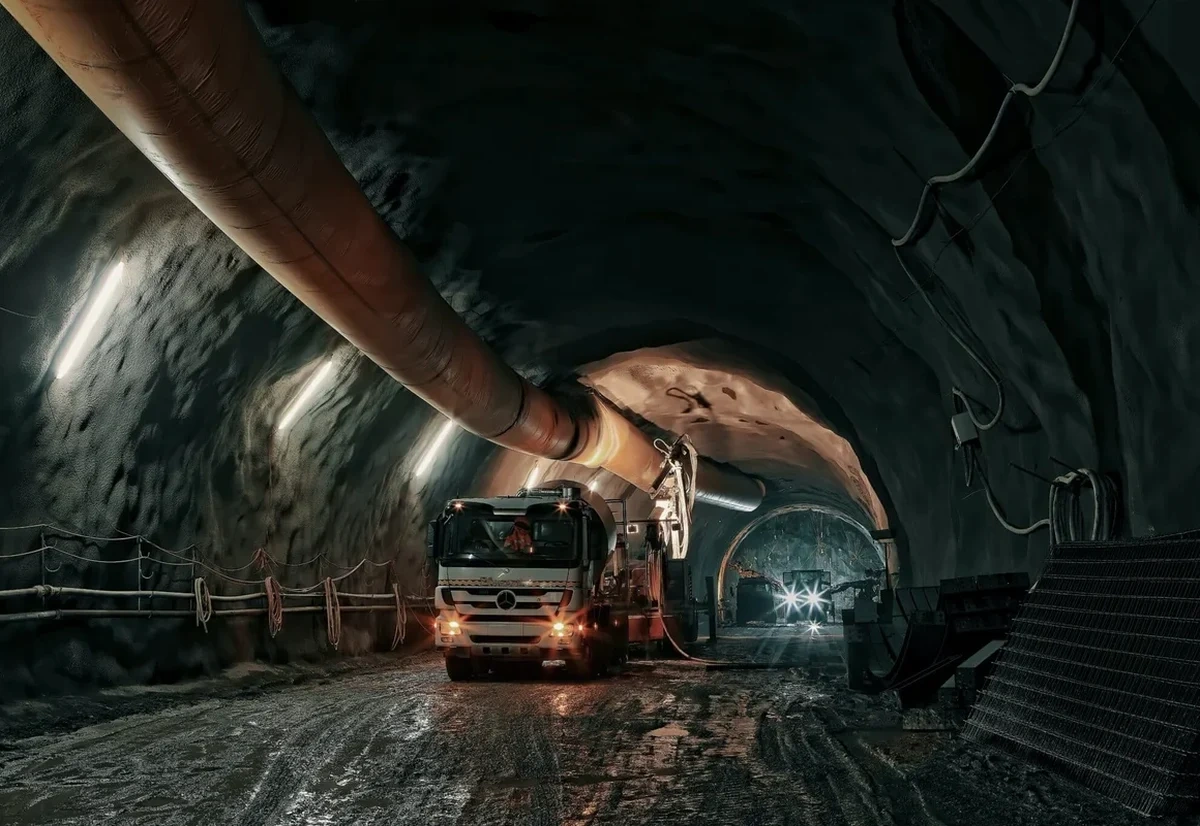
Tunneling through Jackson, Mississippi, presents a set of geotechnical challenges that are inseparable from the local geology. The city sits atop the Jackson Dome, a geological uplift that has shaped the overlying strata, but the near-surface materials are dominated by the Yazoo Clay—a high-plasticity, expansive formation that behaves poorly when disturbed. Any tunnel alignment in the Jackson metro area must contend with the transition zones between the Yazoo Clay and the underlying Cockfield or Sparta sands, where groundwater perched on clay lenses can destabilize the face. ASTM D2487 classification and careful logging of Atterberg limits are not optional here; they are the baseline for predicting squeezing ground behavior. Our laboratory analysis, combined with in-situ permeability testing in the overlying loess-derived silts common near the Pearl River floodplain, provides the hydraulic conductivity values needed to design dewatering systems before a tunnel boring machine ever breaks ground.
In the Yazoo Clay, the difference between a stable tunnel and a costly collapse often comes down to correctly interpreting the effective cohesion intercept from a CIU triaxial test at the design confining pressure.
Local geotechnical context
A 14-foot diameter stormwater interceptor tunnel under Fortification Street encountered a lens of clean Sparta Sand at a depth of 35 feet, directly beneath a section of Yazoo Clay that had been softened by a leaking water main. The contractor advanced the tunnel face expecting stiff clay, but the sudden loss of confinement triggered a rapid inflow of saturated sand that flooded 60 linear feet of the excavation in under two hours. The root cause was an incomplete site investigation that relied on borings spaced 200 feet apart, missing the sand pinch-out entirely. A proper soft ground analysis would have included a continuous seismic refraction profile to map the clay-sand interface, coupled with a pore pressure dissipation test at the suspected transition depth. The cost of the supplemental investigation would have represented less than two percent of the eventual repair budget, which included ground freezing to stabilize the zone and a six-month delay in the project schedule.
Relevant standards
ASTM D1586 – Standard Test Method for Standard Penetration Test (SPT) and Split-Barrel Sampling of Soils, ASTM D2487 – Standard Practice for Classification of Soils for Engineering Purposes (Unified Soil Classification System), ASTM D4767 – Standard Test Method for Consolidated Undrained Triaxial Compression Test for Cohesive Soils, ASCE 7-22 – Minimum Design Loads and Associated Criteria for Buildings and Other Structures (tunnel loading provisions), IBC 2021 (Mississippi adoption) – Chapter 18 Soils and Foundations, FHWA-NHI-10-034 – Technical Manual for Design and Construction of Road Tunnels – Civil Elements
Quick answers
What makes the Yazoo Clay in Jackson particularly challenging for tunnel construction?
The Yazoo Clay is a stiff, overconsolidated Eocene formation with a high plasticity index—often exceeding 30 percent—that makes it prone to squeezing when the in-situ stress is relieved by excavation. Its sensitivity (the ratio of undisturbed to remolded undrained strength) typically ranges from 2 to 5 in Jackson, meaning that disturbance from a tunnel boring machine can reduce the strength by half or more. The formation also contains thin partings of silt and fine sand that act as preferential flow paths for groundwater, creating localized zones of reduced effective stress at the tunnel crown.
How do you determine whether a tunnel alignment in Jackson requires a pressurized-face TBM?
The decision hinges on the stand-up time of the soil at the tunnel horizon, which we evaluate through a combination of SPT N-values, undrained shear strength from triaxial testing, and hydraulic conductivity from in-situ permeability tests. If the Yazoo Clay has been softened by leaking utilities—a common condition under older sections of Jackson—its undrained strength can drop below 1,000 psf, at which point an open-face shield becomes unacceptably risky. In those cases, we recommend an earth pressure balance machine with conditioned muck to control face pressure.
What is the typical cost range for a soft ground tunnel geotechnical investigation in Jackson?
A comprehensive investigation for a tunnel project in Jackson, covering field exploration, undisturbed sampling, laboratory triaxial and consolidation testing, and a geotechnical baseline report, generally falls between US$4,630 and US$15,460. The final figure depends on the length of the alignment, the number of borings required to achieve adequate spatial coverage, and whether supplementary geophysical methods like seismic refraction are needed to map the clay-sand interface.
Which laboratory tests are essential for predicting settlement above a tunnel in soft clay?
The one-dimensional consolidation test is the cornerstone of settlement prediction. We run incremental loading tests on undisturbed specimens trimmed from Shelby tubes, measuring the compression index (Cc), recompression index (Cr), and the preconsolidation pressure. For Jackson’s Yazoo Clay, we also run a few constant-rate-of-strain consolidation tests when the project timeline is tight, because they can produce a full compressibility curve in a fraction of the time. The results feed directly into the volume loss calculations that generate the transverse settlement trough.