← Home · Laboratory

Laboratory CBR Testing in Jackson Mississippi: Subgrade Strength for Pavement Design

Together, we solve the challenges of tomorrow.

LEARN MORE →

A pavement engineer working on a new commercial access road in Fondren faces entirely different subgrade conditions than one designing a residential street in South Jackson. Fondren sits on older, more consolidated Pleistocene terrace deposits, while much of South Jackson and the Highway 80 corridor rests on the expansive Yazoo Formation. That difference shows up immediately in soaked CBR values. A sample from Fondren might hold 8–9% after four days of soaking; a sample from the Yazoo clay belt often drops below 3%. Laboratory CBR testing does not just produce a number for a specification table. It reveals how the soil will behave once construction traffic and seasonal wetting cycles begin. The test measures the load-penetration response of a compacted specimen, comparing it to a standard crushed stone reference. Without this data, pavement thickness design becomes guesswork, and in Jackson’s shrink-swell soils that guesswork leads to early rutting, edge cracking, and base failure within the first two years. For projects where fill quality is also in question, the same laboratory can run a sand cone density verification to confirm compaction levels before the CBR specimen is even molded.

A four-day soak under a 10-pound surcharge simulates what Jackson subgrades endure every wet winter — the CBR value captures that reality in a single number.

How we work

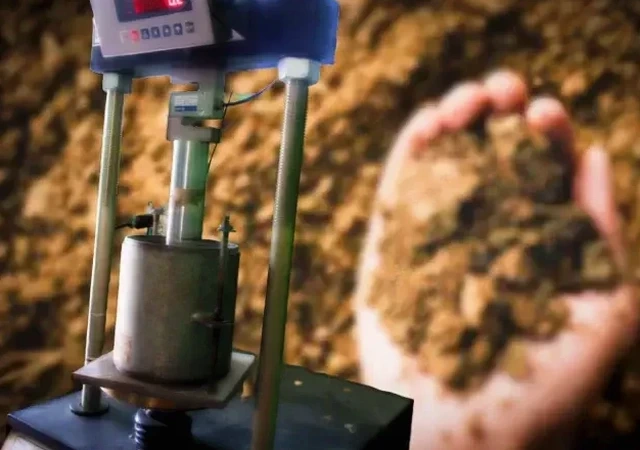
ASTM D1883 governs the laboratory CBR procedure in the United States, and the Mississippi Department of Transportation follows AASHTO T 193 for routine pavement subgrade evaluation. In Jackson, the soaked CBR is far more critical than the unsoaked value because the Yazoo Formation undergoes significant strength loss when saturated. A specimen compacted at optimum moisture and then soaked for 96 hours often loses 40 to 60 percent of its dry strength. Technicians prepare three-point compaction curves, mold specimens at the required density, and run the penetration test with a standardized piston at 0.05 inches per minute. The load at 0.1 inch and 0.2 inch penetration is recorded and expressed as a percentage of the standard load for crushed California limestone. A specimen that reads 5.1 percent CBR at 0.1 inch penetration tells the pavement designer exactly how much asphalt, base course, and subbase material to place above it. When the project involves deeper exploration, the team often pairs this test with SPT drilling data to correlate CBR with N-values down to 20 feet, giving a complete subgrade profile. For stabilized soils where cement or lime treatment is proposed, the laboratory also runs grain size analysis to confirm the fines fraction before treatment begins.
Laboratory CBR Testing in Jackson Mississippi: Subgrade Strength for Pavement Design
Technical reference image — Jackson Mississippi

Local geotechnical context

The Yazoo Formation underlies most of Jackson and much of central Mississippi. This Eocene-age marine clay contains montmorillonite, the same swelling mineral found in bentonite. After four days of soaking under a 10-pound surcharge ring, Yazoo specimens frequently swell 3 to 5 percent and their CBR drops to values that classify the soil as very poor subgrade. A pavement design that ignores this collapse in bearing capacity will fail at the subgrade level — not at the surface. Cracks propagate upward through the base and asphalt, and patching only buys time. A soaked CBR of 2.1 percent requires substantially more aggregate base than a 6.5 percent value, and that difference changes the project budget by tens of thousands of dollars. Mississippi DOT specifications require a minimum laboratory CBR for subgrade acceptance, and failing to meet it triggers costly lime stabilization or undercutting. Specimens that swell more than 5 percent during soaking may require a slope stability review if the pavement sits near an embankment or cut section where lateral water migration is expected.

Need a geotechnical assessment?

Reply within 24h.

Email: contact@geotechnical-engineering1.org

Technical parameters

ParameterTypical value
Standard test methodASTM D1883 / AASHTO T 193
Specimen compactionModified or Standard Proctor per ASTM D1557/D698
Soaking period96 hours under 10 lb surcharge load
Penetration rate0.05 in/min (1.27 mm/min)
Penetration measurement points0.1 inch and 0.2 inch
Specimen diameter6 inches (152.4 mm) — 4-inch mold optional
Typical Yazoo clay soaked CBR range2% to 6% at optimum moisture
Report formatLoad-penetration curve, CBR at 0.1 in and 0.2 in, swell percentage

Related services

01

Subgrade Evaluation CBR Package

Three-point Proctor compaction curve with soaked CBR at each point. Includes swell measurement, moisture-density relationship, and CBR report formatted for MDOT submittal. For projects across Jackson's variable geology, we test specimens from each major soil unit encountered in the borings.

02

Construction Verification CBR Testing

Target-density CBR testing during fill placement and subgrade preparation. Specimens compacted to the project specification's required density and tested soaked or unsoaked per the engineer's direction. Turnaround in 3 to 5 business days.

Relevant standards

ASTM D1883 — Standard Test Method for California Bearing Ratio of Laboratory-Compacted Soils, AASHTO T 193 — The California Bearing Ratio, ASTM D1557 / D698 — Standard Test Methods for Laboratory Compaction Characteristics, Mississippi DOT Standard Specifications for Road and Bridge Construction (latest edition)

Quick answers

What does a laboratory CBR test cost in Jackson?

A standard soaked CBR with Proctor compaction curve typically ranges from US$120 to US$200 per specimen, depending on whether it is a single-point or three-point determination. Three-point curves provide better data for pavement design but require more technician time. The final cost depends on the number of soil units being tested and the required turnaround schedule.

Why is the soaked CBR more important than unsoaked for Jackson soils?

Jackson sits on the Yazoo Formation, a high-plasticity marine clay that swells and loses strength when wet. Unsoaked CBR values can look acceptable — sometimes 15 percent or higher — but after 96 hours of soaking they often drop below 4 percent. Pavement design must use the soaked value to account for what actually happens during Mississippi's wet winters and spring seasons.

How does laboratory CBR differ from a field CBR test?

A laboratory CBR uses a remolded, compacted specimen tested under controlled moisture and density conditions, which makes it reproducible and ideal for pavement design curves. A field CBR test measures the in-place soil strength but does not control moisture or density. Mississippi DOT typically uses laboratory CBR for design and field CBR for construction verification. The two values correlate but serve different purposes.

How long does a laboratory CBR test take to complete?

The soaking period alone is 96 hours. With compaction, molding, soaking, and penetration testing, a full three-point CBR test takes approximately 5 to 7 working days from sample receipt to final report. Expedited schedules are possible when the project timeline requires it, but the four-day soak cannot be shortened per ASTM D1883.
Location and service area

We serve projects in Jackson Mississippi and surrounding areas.

View larger map