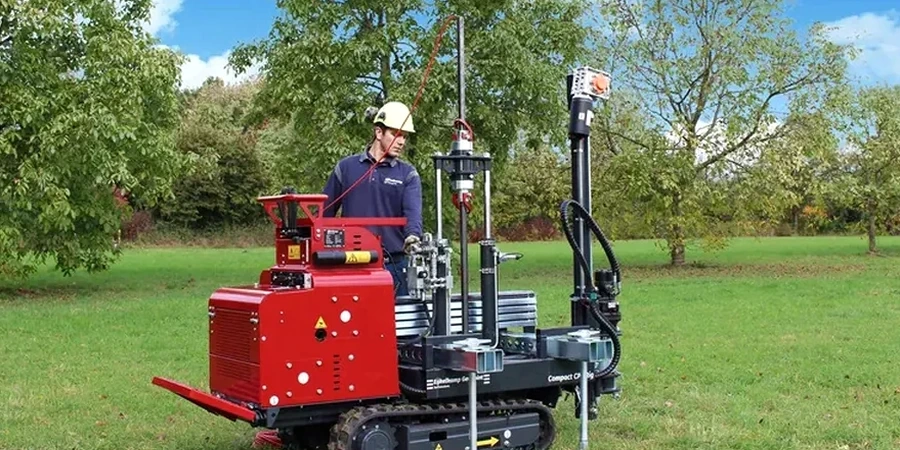
Jackson's expansion eastward into the Pearl River valley and north toward the Ross Barnett Reservoir has pushed development onto some of the most variable soils in the Southeast. The city sits on the Jackson Dome, an ancient volcanic uplift that left behind a thick blanket of Yazoo Clay — a high-plasticity, overconsolidated formation that swells when wet and shrinks dramatically in Mississippi's summer heat. Traditional drilling can be slow and messy in this material. That is why we run the CPT rig on nearly every commercial project east of I-55. A test pit works fine for shallow utility checks, but when you need to map the transition from the loess mantle into the underlying clay at 20 to 40 feet, nothing beats the continuous data stream from a cone penetration test. We tie the results directly into the slope stability analysis when the site has any grade change at all — and in Jackson, that is most sites.
In Jackson's Yazoo Clay, a CPT sounding maps the active zone of moisture fluctuation with centimeter-level precision — something no SPT can do.
How we work
Jackson sits at roughly 280 feet above sea level on the Jackson Prairie belt, and the water table in the Terrace deposits can be as shallow as 8 feet in the wet season. This means pore pressure dissipation tests during CPT soundings become critical for foundation design. Our 20-ton CPT truck pushes a 15 cm² cone at 2 cm/s, recording tip resistance, sleeve friction, and dynamic pore pressure every 2 cm. We run the test per ASTM D5778 and classify soil behavior type using the Robertson (1990) chart — a method that maps directly to the IBC site classification requirements. In the silty clays of Fondren and Belhaven, the friction ratio typically falls between 3 and 6 percent, which tells us immediately whether we are in stiff Yazoo Clay or a softer alluvial lens. A single sounding to 60 feet gives more stratigraphic detail than three borings with split spoons, and we can push four locations in a day if access is decent.
Local geotechnical context
The CPT rig we run in Jackson is a 20-ton track-mounted truck with a hydraulic push system that forces the cone rod into the ground at a constant rate. No drilling fluid. No cuttings. No hollow-stem auger wrestling with sticky clay. In our experience, the most common failure we see in Jackson foundations comes from designers assuming the Yazoo Clay is uniform. It is not. A CPT profile will often reveal a desiccated crust down to 10 feet, then a transition zone where the moisture content jumps, then fully saturated stiff clay below 25 feet. If you design a shallow footing based on the crust strength and ignore the softer zone underneath, differential settlement shows up within two seasons. We have pulled cone data from a site off Lakeland Drive where the tip resistance dropped from 2 MPa to 0.4 MPa over a vertical distance of just 18 inches — a buried silt seam that a standard boring with SPT at 5-foot intervals completely missed. In Jackson, missing that seam means cracked slabs and angry owners.
Quick answers
How much does a CPT test cost in Jackson?
For standard CPT soundings in the Jackson metro area, budget roughly $190 to $230 per push location depending on depth and whether piezocone or seismic modules are needed. A typical 3-location commercial site program runs between $1,800 and $2,500 including mobilization and a signed report.
Can CPT replace soil borings for a Jackson building permit?
In many cases, yes. The IBC accepts CPT data for site classification and foundation design parameters. However, if the Jackson building official requires a minimum number of SPT borings or undisturbed samples for shrink-swell testing (common in Yazoo Clay), we supplement CPT with targeted sampling. We recommend confirming with the city's permit office during scope planning.
How deep can you push the cone in Jackson's clays?
In the stiff Yazoo Clay formation, we routinely reach 60 to 80 feet with a 20-ton push system. Deeper soundings to 100 feet are possible but depend on the moisture profile — dry, desiccated crust near the surface can require pre-drilling the upper 3 to 5 feet to avoid rod buckling.
What is the turnaround time for CPT data?
We provide raw cone data and preliminary soil behavior type logs within 24 hours of field work. A full geotechnical report with bearing capacity estimates, settlement analysis, and IBC site classification is typically delivered in 5 to 7 business days.
Do you need special site access for the CPT truck?
Our CPT rig is track-mounted and needs about 8 feet of width clearance. It works well on undeveloped lots, but tight urban sites in Belhaven or Fondren with mature trees and narrow side yards may require a smaller push system. We do a free site walk before mobilizing to confirm access.