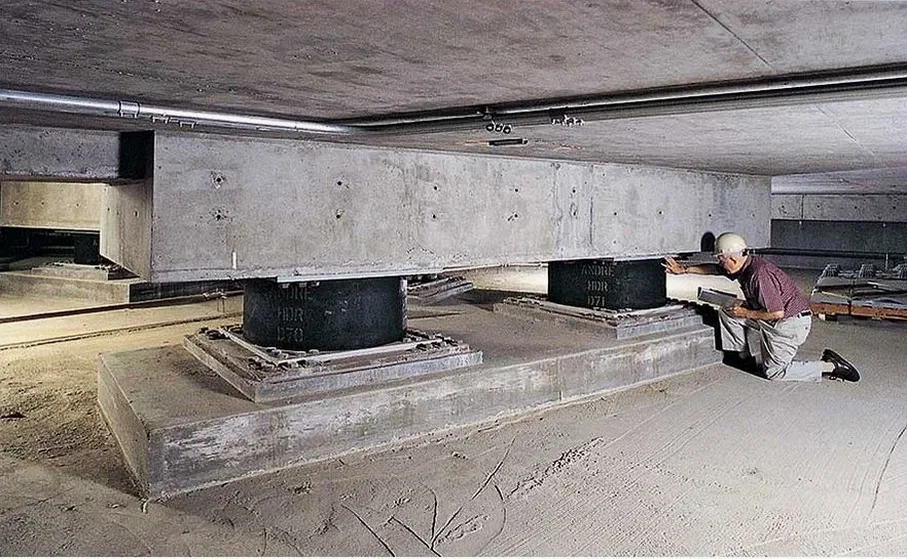
Jackson sits squarely on the Jackson Prairie, a belt of Eocene-age geology underlain by the notoriously expansive Yazoo Clay formation. This isn't just textbook geology; it's a daily reality for any foundation engineer working in Hinds County. When you combine reactive clay soils with the region's position in a moderate seismic hazard zone, as defined by recent USGS maps, the challenge for structural integrity becomes a dual threat. Base isolation seismic design addresses this directly: it decouples the building from ground motion rather than trying to brace against it. For projects near the Pearl River floodplain or the downtown core, we integrate site-specific Class C and D soil profiles with an in-situ permeability assessment to anticipate how groundwater migration affects the isolator pedestals during a seismic event.
In Jackson's Yazoo Clay terrain, base isolation doesn't just reduce drift—it prevents the foundation from amplifying the very ground motion that a rigid structure would fight against.
Quick answers
What does base isolation seismic design cost for a building in Jackson?
For a typical mid-rise project in the Jackson metro, the combined geotechnical investigation and structural design of the isolation system ranges from US$3,590 to US$7,430 depending on the number of isolators, the complexity of the soil profile, and the peer-review requirements. This covers the site-specific response spectrum, isolator characterization, and the full design package stamped by our Mississippi-licensed engineer.
How does the Yazoo Clay affect base isolation performance?
Yazoo Clay is a high-plasticity Eocene deposit that can soften significantly with seasonal moisture changes. Under a base isolation scheme, the isolator pedestals concentrate the building's weight onto discrete points. If the clay's undrained shear strength drops below the bearing demand during a prolonged wet cycle, you get tilting. Our design counters this by specifying a chemically stabilized pad beneath each pedestal and by setting the isolator's initial stiffness to accommodate a small amount of long-term settlement without locking up.
Is base isolation practical for existing buildings in Jackson?
It is practical for buildings with a structural frame that can be temporarily lifted or jacked, typically steel or concrete moment frames. We perform a detailed condition survey and a MASW scan to confirm the foundation's integrity before cutting the columns. The retrofit involves installing temporary jacking towers, cutting the ground-floor columns, lowering the isolators onto new pedestals, and reconnecting the utilities with flexible loops. The process usually takes four to six months on site, but the building can remain partially occupied during much of that time.